
BioProtocols, Apr 2026
Yagmur Keser, Steeve Boulant, and Megan L. Stanifer
Assessment of Epithelial Barrier Integrity by TEER and FITC-Dextran Permeability Assays
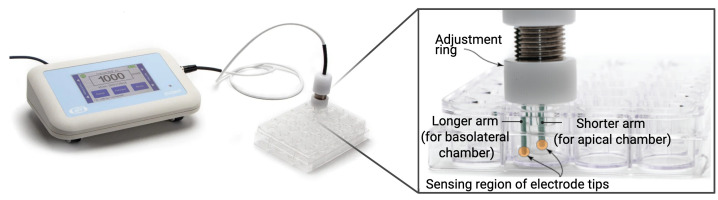
The integrity of epithelial barriers is essential for maintaining tissue homeostasis, particularly in the intestinal tract, where it separates the host from the complex luminal environment. Two complementary, standard methods for assessing this barrier are transepithelial electrical resistance (TEER), which provides a rapid, non-destructive measure of ionic conductance across tight junctions, and the fluorescein isothiocyanate (FITC)-dextran assay, which directly quantifies paracellular macromolecule flux. This protocol details a robust and reproducible method for performing both assays using intestinal epithelial cell monolayers (e.g., Caco-2, T84) cultured on permeable Transwell supports. We outline the procedure from cell culture and monolayer differentiation to TEER measurement with an Epithelial Volt/Ohm Meter 3 (EVOM3) and the subsequent FITC-dextran permeability assay. By combining these techniques, this protocol provides a comprehensive assessment of barrier function, making it ideal for studying tight junction dynamics and regulation under various experimental conditions, such as cytokine stimulation, drug screening, or microbial challenges. Key features • Combines electrical resistance (TEER) and macromolecular flux (FITC-dextran) assays for a comprehensive assessment of intestinal epithelial barrier integrity. • Applicable to various intestinal models, including Caco-2 and T84 cell lines; can be applied to other immortalized or primary epithelial and endothelial cells. • Utilizes the Epithelial Volt/Ohm Meter 3 (EVOM3) for accurate, non-destructive, and rapid TEER measurements in intestinal epithelial cell monolayers. • Provides clear guidelines for EVOM3 electrode handling and measurement to ensure reproducible results.
Visit Journal